Thursday, 16 December 2021

Voodoo People Like Us -私たちのようなブードゥー人間-

“Magic people: Voodoo people,

The voodoo who do what you don’t dare do, people.”

From the Prodigy song, “Voodoo People”


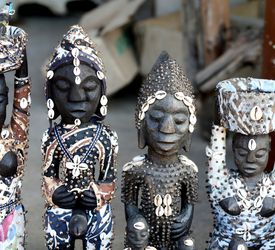
Do you remember the scene in the Indiana Jones movie, “The Temple of Doom” in which an evil child sticks a pin into a doll?  The doll represented Indiana Jones, and whenever the pin was stuck into the doll’s body, the real Indiana Jones started screaming in pain. 

This scene seems to be based on the idea of a Voodoo doll.  The movie is set in India and Voodoo originated in West Africa, so it was a little strange to use it in the movie.  But I can’t think of a better example of Voodoo dolls in popular culture. 

Not many people reading this blog will believe that sticking a pin into a doll representing your enemy can really cause that enemy to feel pain.  But it is not hard to believe that sticking the pin into the Voodoo doll can bring you pleasure! 

I recently read about a scientific study in which people were asked to remember a time when they were the victim of an injustice – for example, to remember a time when they were bullied at work.  Then half of the people studied were given the chance to stick a pin into a representation of the person who had wronged them, and half were not.  According to the researchers the people who stuck the pins in (actually, they stuck “virtual pins” into an image on a computer screen) experienced positive mental benefits.  Their feelings of injustice and victimhood were lessened by the symbolic act of revenge.  Even though their enemy in the real world was not harmed, they still got some psychological benefit from taking action to harm a representation of their enemy. 

So now you know what to do the next time your boss asks you to do overtime.


Thursday, 9 December 2021

Making Mummified Chicken, Korean Style -韓国風鶏のミイラを作ること-

“Oh, God,” I thought, “Let the dessert be small!” 

I had already eaten crispy vegetables in batter, fruit wrapped in kimchee, toppogi (pounded rice), chijimi (a bit like a pancake), dak hanmari (a whole chicken and vegetable hot pot), and udon noodles.  I was full before the end of the chicken hot pot.  Like a soldier going into battle, I got through the hot pot and the udon, feeling my belly bulge against my waistband. 

“Maybe it will be one scoop of ice cream, or a single wafer of chocolate?” I hoped. 

Then the waiter announced annin dofu in lemon (a sort of sweet curd made from apricot kernel).  And I prepared for one last battle. 

I was in a lovely Korean restaurant in Ebisu called Suragan.  It was a birthday treat and so I ordered the 4,500 Yen lunch course.  It was very good value, and the chijimi was particularly nice.  I had only ever eaten it in cheap izakayas before, and I was surprised at how fluffy and light it was. 

But I really wanted to try the dak hanmari hot pot.  It was very interesting.  The waiter had us test the soup to see if it was acceptable, before we started, as customers test a bottle of wine before the waiter pours a full glass.  The soup was indeed very rich and tasty. 

The trouble is, especially for a blind person, it is rather difficult to eat a whole chicken in soup with chopsticks.  I had to pick a bit out with the chopsticks, try to find a bony bit, and then hold the bone with my fingers while I tore off the meat.  And the restaurant provided a little pot to put the bones into.  My wife commented that it put her in mind of the process of creating a mummy.  I know what she meant.  In ancient Egypt the embalmers used lots of little pots to put in various body parts that could not be preserved. 

For a Scotsman like me, one of the benefits of living in Tokyo is the quality of Asian restaurants.  Of course the Japanese food is nice.  But there are also lots of Koreans and Chinese living here.  And there are good Vietnamese and Thai restaurants too.  Scotland has good Indian and Cantonese restaurants, but not so many nice restaurants from other Asian countries. 

I’ll be sure to enjoy Korean food again.  But maybe a smaller course next time.


Thursday, 2 December 2021

Half a Glass of Chilled Beer -グラス半分の冷えたビール-

French philosopher Jean-Paul Sartre once wrote a play in which three characters are punished in the afterlife by being forced to spend an eternity locked together in a room.  This is sometimes summarised in the phrase, “Hell is being locked in a room with your friends”, or just, “Hell is other people.” 

Sartre’s vision of Hell came to mind this week when more than sixty people were trapped for several days and nights in a pub in the north of England.  People gathered at the pub to see an Oasis tribute band when there was a sudden flurry of snow.  The pub became cut off, and the concert-goers as well as the band were snowed in.  The strangers had to sleep on floors and sofas, and spend days trapped in a small space with strangers, listening to covers of Oasis songs.  Sartre probably would have committed suicide by the second day. 

But being stuck in a pub has its good points too.  English poet William Blake once said, “A good local pub has much in common with a church, except that a pub is warmer, and there is more conversation.” 

Perhaps a comparison of Sartre and Blake says something about the differing temperaments of the English and the French? 

The snowed in patrons seem to have sided with Blake, and taken the view that their glasses were half-full, not half-empty.  Speaking to the media about the incident, the pub owner said, "All of our guests have just been wonderful, so we've been incredibly lucky. They've been very supportive, understanding and patient.”  She said customers had helped out with washing up, clearing tables and collecting glasses. 

I must say that I’m not a big fan of Oasis.  After hearing a dodgy cover version of Wonderwall for the fiftieth time in four days, I probably would have agreed with Sartre.


Vocabulary:

a tribute band – a band that plays only cover versions of one particular band

a flurry of snow – a sudden heavy snowfall

to be snowed in – to be trapped and unable to leave because of heavy snow

a patron – a customer; someone who supports a business etc. with their money

dodgy – of low quality; unreliable


Thursday, 25 November 2021

Fried Rice, Fried Rice, Fried Rice, Repeat -炒飯、炒飯、炒飯、繰り返し-

An American with Chinese ancestry told media this week that he has eaten at over 7,800 different Chinese restaurants, mostly in the U.S..  Mr. Chan is 72 now, and has been keeping a record of all the different Chinese restaurants he has visited since the 1960s, when he became interested in exploring his cultural heritage

You’ve got to admire the tenacity of Mr. Chan.  If you were to go to a different Chinese restaurant every night of the week for ten whole years, you would still not have eaten at half the number of Chinese restaurants that he has.  Would you really never once fancy some pasta, or cous cous, or sushi instead? 

And also, if your goal is to explore your Chinese heritage, and you still haven’t satisfied yourself after thousands of hours spent sitting in front of plates of fried rice and dim sum, mightn’t you be going about it the wrong way?  Perhaps Mr. Chan could have used some of the hours spent in restaurants reading Confucius and Sun Tzu, or practicing calligraphy instead. 

And I wonder what happens to a man who has had 7,800 fortune cookies?  Isn’t he tempting fate?  One day a really unlucky fortune cookie will just say, “In ten seconds you will die from an overdose of prawn crackers!” 

Good luck, Mr. Chan.  It’s nice to have a passion in life. 


Vocabulary:

to have (Chinese) ancestry – for your parents, or grandparents, or great-grandparents, etc., to have come from (China), even if you may have been born elsewhere

your cultural heritage – the culture that is passed down to you from earlier generations, such as your parents

tenacity – the property of continuing, without giving up

to fancy something – to feel like something; to have a slight desire for something

to tempt fate – for superstitious people, to act in a way that might cause a supernatural power to want to cause you harm.  For example, boasting about how lucky you are might be seen as tempting fate, since the jealous gods might want to give you bad luck instead.


Friday, 19 November 2021

The Fall and Rise of Yumenishiki Anko and the Sumos from Nerima -練馬出身、夢錦安子の栄枯盛衰-

My son’s nursery holds a sumo tournament every year, and it has been taking place over the last week.  The nursery students are each asked to choose a sumo name, and then they fight each other in a round robin style tournament.  They each fight two bouts a day, and if they win they get a star next to their name. 

My son’s sumo name is “Yumenishiki Anko”.  He fought as Yumenishiki last year, when he was four, and got no stars next to his name at all.  He lost every bout.  If I were a nursery teacher, I would probably set up the tournament so that every child could win at least one time.  But at this nursery, it’s a hard lesson in life. 

I didn’t want my son to lose every bout again this year, so I have been practicing sumo with him at home.  “Push, push!” I encourage, or, “Go for my shoulders.  Oh, no – I’m falling over!” 

Sadly, on the first day of the tournament, my son lost both bouts.  Then on the next day, he lost both bouts again.  He seemed quite upset. 

Then on the third day he fought against another student who had also lost every bout.  And Yumenishiki won!  He lost the other bout that day, but he came home very happy. 

“Daddy, Daddy, I won!” he said.  Then he switched language, talking to me in Japanese.  “Ore mecha yowai no ni, X-kun wo taoshita!  X-kun ga mecha mecha yowai, ne!”  In English I might translate that as, “Even though I’m dead weak, I pushed over X.  He’s dead, dead weak!” 

I feel sorry for the boy I have called “X-kun”.  It is very early in life to feel weaker than your peers. 

But Yumenishiki took great confidence from knowing that he was no longer considered the weakest.  On the next day, he won both bouts.  “Ore sugoi tsuyoi yo ne, Daddy,” he now tells me – “I’m amazingly strong, aren’t I Daddy?” 

Perhaps in a few years he will be able to beat me, even if I don’t crouch down.


Vocabulary:

a round robin – A style of competition in which each competitor plays every other competitor.  The football World Cup starts with a round robin section

a bout – a match, especially in some combat sports

one’s peers – one’s social equals


Thursday, 11 November 2021

Windswept and Interesting Parenting -吹きさらしで興味深い子育て-

I recently read the autobiography of the Scottish comedian, Billy Connolly.  It is called, “Windswept and Interesting”.  Connolly recommends living your life as a windswept and interesting person, rather than as a neat and ordinary one.  If you are windswept then you look untidy after being exposed to the wind.  Perhaps your hair has been blown into a chaotic state.  For Connolly this is one sign of an interesting person. 

Connolly grew up in a working-class area of Glasgow.  He tells an interesting story about the parenting style of one of his neighbors. 

A family who lived near Connolly when he was a small boy had nine children.  In those days the children were left to play outside by themselves, or with the other children of the neighborhood. 

“I’m going to the pub for a drink,” said the father of the nine children. 

“Oh, no you’re not,” said his wife.  “Not until you bring our children in from playing outside and put them all to bed.” 

Annoyed at being delayed from going to the pub, the father goes outside and picks up the first nine children he sees, brings them into his house, and puts them all to bed.  Then he goes off for a drink.  The nine children included seven of his own children, and Billy Connolly and his sister, who just happened to be playing near the man’s house. 

When Connolly’s family went looking for him, they found two children crying outside the house.  “We can’t get in,” they wailed.  “The bed’s full of people!” 

This is a windswept and interesting style of parenting.


Thursday, 4 November 2021

Thoughts of a Fiction 20 Per Center -フィクション小説二割さんの考え-

I heard on the news recently that in Britain 80 per cent of fiction sales are to women, and only 20 per cent to men. 

Men are just less likely to read books, and less likely to listen to audio books.  And for those men who do read, they read a higher proportion of non-fiction than women do.  I wonder why? 

Since non-fiction contains truth, and fiction contains lies, perhaps the simple answer is that women are more comfortable with lies than men are! 

Or maybe women are better at empathising than men.  To read a novel to the end, you have to care about the characters.  Maybe men just don’t care.  “So Harry Potter’s parents both died and he is an orphan.  So?  It’s a tough life.  Grow up and stop complaining!” 

I am one of the 20 per cent of fiction readers who is a man.  I have been listening to The Pickwick Papers by Charles Dickens recently.  But I have also been reading less fiction and more non-fiction as I get older.  My last two books before I started Dickens were an autobiography of a great Scottish comedian (“Windswept and Interesting”, by Billy Connolly) and a travel documentary (“Michael Palin: Around the World in 80 Days”).  I must be becoming more manly.


Vocabulary:

to empathise – to understand and share the feelings of others

an orphan – a child whose parents are dead

manly – having the good qualities traditionally associated with men, such as courage and strength