Thursday, 28 April 2022

How to Charm a Gorilla, and other Tales -ゴリラを魅了する方法、それから他のお話-

I recently asked some of my students these questions: “If you had to steal an animal from a zoo, which one would you steal?” and, “How would you steal it?”

Here are some of the answers they gave me.


1

“I would steal a koala, because they are not aggressive, and would be easy to carry,” said one woman.

“I would enter the zoo carrying a fake baby in a poncho.  I would enter the koala enclosure and hide it under the poncho.  Then I would simply walk out of the zoo, pretending that my baby was asleep.”

It’s a simple strategy, but it might work.


2

Another female student was more ambitious.

“I would steal a gorilla,” she said.

“I would bribe one of the staff to let me into the gorilla enclosure after the zoo had closed.  I would be dressed in a gorilla suit.”

A gorilla suit?

“Yes,” she enthused.  “The gorilla would see me and think I was a gorilla too, and follow me out of the zoo.”

This sounds like a risky strategy.  What if the gorilla thinks you are cute?


3

“I would steal a chameleon,” said a third student. 

“I would carry it out in my handbag.  And nobody would notice that it was missing for a long time.  All the visitors looking into the place where the chameleon should be would just think that it was very well camouflaged.” 

Good point. 

* 

For legal reasons, I would like to say that I do not encourage anyone to steal animals from a zoo.  It is just an exercise designed to stretch the imagination!


Vocabulary:

an enclosure – an area that is surrounded by a barrier

to bribe someone – to pay someone money or give someone a gift to persuade them to do something dishonest or illegal to help you

to enthuse – to express eager enjoyment or interest; to speak enthusiastically

to be camouflaged – to be hidden by looking similar to the surrounding environment


Thursday, 21 April 2022

Walking Out, Tentacle in Hand -タコの足を握って出掛ける-

I was interested by two very different news items this week.

In the first, a scientist from Oxford University warned against trying to contact alien species.

“The trouble is, we don’t know what proportion of alien civilizations is hostile, and what proportion is friendly,” he said. 

In the second news item, a woman who went on her second date with a man got irritated with him when he made a rude comment about another woman they passed on the street. 

The stranger, who was holding a flower in her hand, looked unhappy.

“What’s wrong with her?” said the man on the date.  “Why doesn’t she cheer up?” 

The man’s date got annoyed by his harsh comment, saying, “There could be many reasons she is unhappy.  Maybe she is coming back from a funeral!”

So she broke off her relationship.

What would happen if a human went on a date with an alien?  Could human and alien get along?

I fell in love with an alien being,

Whose skin was jelly, whose teeth were green.

I was over the moon, I asked her back to my place,

Than I married the monster from outer space.


We walked out, tentacle in hand,

You could sense that the Earthlings did not understand.

They’d go, nudge-nudge when we got off the bus,

Saying, “That extra-terrestrial’s not like us.”

Edited extracts from John Cooper-Clark’s poem, “I married a monster from outer space” 

I think John Cooper-Clark is right.  A human-alien date would experience problems.


Vocabulary:

a tentacle – a flexible limb used by some underwater creatures to grasp objects.  An octopus has eight tentacles

to be hostile – to show opposition or to be unfriendly

to be irritated – to be slightly angry or annoyed

a funeral – a ceremony held after someone has died, usually including their burial or cremation

to be over the moon – to be delighted

nudge-nudge – to nudge someone is to poke them gently, often with an elbow.  This is usually done to attract someone’s attention without other people noticing.  In the poem, people nudge each other as the human-alien couple pass.  It is a way to show their disapproval without being noticed by the unusual couple.


Thursday, 14 April 2022

More Than Human -人間プラス-

I read a story this week about a Dutch man who has had a microchip implanted under his skin.  This allows him to pay for items in a supermarket or shop just by waving his hand in front of the scanner.  Cashiers are often amazed to see him paying without using any cards or his smartphone, as if by magic.

Is this the future?  Are humans going to put more and more gadgets inside their bodies, like weird science fiction characters?  And if so, what gadget implants will come next?  Here are a few things I would like to see developed.


1 – A third hand. 

This robotic hand would be attached to the back of one of your arms.  It could be used for touching and picking things up which you didn’t actually want to touch with your skin.  For instance, during a future coronavirus pandemic, people would shake hands only with their robotic third hand. 

2 – A proximity warning system 

Are you tired of people on the street bumping into you because they are looking at their smartphones, and not looking where they are going?  If they have a radar system implanted beneath their skin, it will beep a warning when they are about to collide with something.  Cars have this system for use when parking.  Why not people?

3 – Under the skin perfume dispenser 

With so many electrical gadgets attached to your body, it is going to be dangerous to take a shower.  So you will need a perfume dispenser implanted beneath your skin.


Vocabulary:

Dutch – of or from the Netherlands

a gadget – a small mechanical or electrical device or tool, especially an unusual or cleverly designed one

an implant – something placed inside the body using surgery, such as a medical tool to monitor the heart

proximity – nearness

to collide with something – to hit something; crash into; bump into


Thursday, 7 April 2022

That’s What They All Say -みんな、そう言うのよー

One of my students had a very odd and disturbing experience in a Docomo shop in Japan recently.

Her smartphone was getting quite old and wasn’t working so well, so she wanted to upgrade to a newer model.

She visited her local Docomo shop to buy one.

“I can’t sell the mobile phone to you until I’ve called one of your family members to get permission,” the salesman said.

My student is in her early seventies, and is very active and capable.  “You don’t have to check with my family before selling me a phone!” she said, “I’m not suffering from dementia!”

“That’s what they all say,” said the salesman, and he refused to sell her the phone unless he could call a family member.

My student’s children were all at work and did not pick up their phones.  So she had to give up on buying a phone that day.  The salesman apologised to her and said that Docomo had a policy of not selling phones to any person over the age of 65 without getting the permission of a younger family member.

I couldn’t believe this.  It seemed like an obvious case of discrimination.  If this policy were true, then Japan’s prime minister, Mr. Kishida would soon be unable to purchase a mobile phone without getting someone’s permission, even though he could decide to raise taxes or impose sanctions on Russia.  Mr. Kishida turns 65 this year.

When I got home, I did an internet search for Docomo’s customer policy guidelines, to see if this salesman was correct.  He was actually not quite right.  Docomo’s guidelines say that the sales staff may refuse to sell a phone to customers over the age of 80 (not 65) unless a younger family member gives permission.  The reason for this policy is not clearly stated, but I guess it is to avoid pushy salesmen twisting the arms of vulnerable elderly customers to buy an expensive phone that they don’t really need.

What does an elderly person do if they don’t have any family willing to help?


Vocabulary:

to be capable – to have the ability to do something (or many things)

dementia – an illness which causes people to become forgetful or causes a decline in their mental abilities

discrimination – the treatment of people differently, and in an unfair way

pushy – aggressive or overly forceful in dealing with other people

to twist someone’s arm – to put pressure on someone (to do something)


Thursday, 31 March 2022

Wolf -オオカミ-

I edited this from one of Aesop’s fables.  It made me think of recent news events.


The Wolf and the Lamb

The wolf wished to be seen as a responsible and moral creature, and so he swore to all the animals that he would not do violence to any creature unless he was first provoked.

One day the wolf came across a lamb in a meadow, which had gone astray.

The wolf said, "Young lamb, last year you grossly insulted me."

"You must be mistaken," bleated the lamb nervously, "I was not then born." 

Then the wolf said, "You take grass from my meadow."

"No, good sir," replied the lamb, "I have not yet tasted grass."

Next, the wolf said, "Then you drink water from my river."

"No," exclaimed the lamb, "I never yet drank water, for as yet my mother's milk is both food and drink to me."

Upon hearing this, the wolf seized him and ate him up, saying, "Well! Even if you are not guilty of these things, I cannot feel safe with you standing in my meadow.”

The tyrant will always find a pretext for his tyranny.


Vocabulary:

to swear something – to make a strong promise

to be provoked – to be made angry or given justification for a negative reaction

to go astray – to become lost from a group

to be grossly insulted – to be deeply insulted

to bleat – to make a noise like a sheep

a tyrant – someone in power who abuses their power

a pretext – something given as a reason for taking action, which is not a real reason, but just an excuse for the action


Thursday, 24 March 2022

The Strange Thoughts of a 5 Year Old Boy -5才の坊やの不思議な考え-

I was recently listening to the Bonnie Tyler song, “Total Eclipse of the Heart”.  My son is interested in space and eclipses.  A solar eclipse happens when the moon passes between the Earth and the Sun, blocking the Sun’s light, and making the Earth darken briefly.  My son asked me why the song mentioned an eclipse. 

“In an eclipse, the Earth becomes dark.  In this song, she is very lonely, because her boyfriend has left her.  So she feels cold and scared, like being in the darkness of an eclipse.” 

“Why did her boyfriend leave?” my son asked.  “Was he eaten by dinosaurs?” 

That is an interesting image of how a relationship ends. 

Sometimes I am amazed to see how much smarter my son is getting as he gets older.  At other times I can’t help but laugh at his odd ideas about how things work.  Here are a few other odd things he has said recently. 

We watched a YouTube video about volcanoes.  “What would you do if you were standing near a volcano and it erupted?” I asked.  “The hot lava might come out and get you!” 

“Don’t worry, Daddy,” he answered.  “I would just turn the volcano upside down.” 

I suppose if the crater from which the lava was emerging were switched to the bottom, that could work.

My son also likes to ask me questions. 

He asked, If you fall into an infinite hole, Daddy, and I have infinite power, can I save you? 

What a good question. 

He also asked, are vampires troubled by mosquitos? 

It would be a kind of poetic justice if they were – the king of the blood thieves followed by hundreds of little blood thieves.


Vocabulary:

upside down – For the part normally at the top to be at the bottom, and the part normally at the bottom to be at the top.  If you turn a glass of water upside down, then the water will spill out.

a crater – a large gap or hole in the ground, shaped like a bowl.  There are craters on the moon, caused by large rocks crashing into the surface.

infinite – continuing forever, without end


Friday, 18 March 2022

A Dog’s Life -犬の人生-

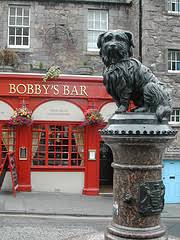
I read some inspiring stories about dogs recently, because it is the 150th anniversary of the death of Greyfriars Bobby. 

Bobby was a dog in 19th Century Edinburgh who showed remarkable dedication to his owner after the man’s death.  Bobby spent his days sitting by his former owner’s grave for 14 years after he had died.  A statue now commemorates the loyalty of the dog. 

The Japanese dog Hachiko is similarly remembered for his loyalty to his owner.  The dog would meet his owner at Shibuya Station every day as he came home from work.  He continued to turn up at the station for ten years after his owner’s death, hoping to see him again. 

On the other hand, I am reminded of American comedian Bill Hicks’ observations about his dog and cat. 

“My dog is truly remarkable,” he said.  “He thinks it is his duty to protect my property.  Every time the mailman or a salesman comes to the door, he rushes up and barks at them.  It is as if he is saying – Be careful, be careful, I’m watching you!  This is Bill’s stuff.  Don’t steal it, I’m watching you!” 

Bill continued, “My cat has a different attitude.  When the dog gets agitated and starts barking at visitors, the cat just looks up lazily.  He seems to be saying – What are you getting in a panic about?  Bill’s got home insurance, you know.” 

“And do you know what?” said Bill, “Though the dog works like mad, and the cat does nothing at all, I feed them both the same.  Who’s the smart one?” 

* 

I’m more of a cat person too.


Vocabulary:

to commemorate something – to recall and show respect for something, especially in a formal way, such as a ceremony, public statue, etc.

to get agitated – to become troubled or in a state of nervous energy