Thursday, 16 October 2014

A cat lover by nature


Are you a cat lover?  I am.  When I was young, my family bought a cat from a dog and cat home.  That means that she had been owned by another family who had decided they didn’t want her and gave her away.

So we didn’t decide her name.  She already had the name “Domino”, since she was a white cat with black spots.  A domino is a small rectangular black block with white spots, used in a game.  So the name was quite appropriate. 

Domino was very shy and nervous at first.  She didn’t like to be touched by humans much and would sometimes turn around and give us a warning bite if we tried to pet her.  I would probably be shy and nervous if I had been thrown out by my family too. 

But after many months and years she got used to people.  She became very friendly and would jump onto your lap to be petted.  You could say that over time she learned to change her nature. 

But Aesop would disagree.  Below is another one of his fables, in which he suggests that someone or something’s essential nature can never change. 

He also has a different idea of what is meant by a ‘cat lover’...


The Cat Maiden 

The gods were once disputing whether it was possible for a living being to change its nature.  The king of the gods said "Yes," but the goddess of love said "No."
So, to resolve the dispute, the king of the gods turned a cat into a maiden, and gave her to a young man for a wife.  The wedding was duly performed and the young couple sat down to the wedding-feast.
"See," said the king of the gods, "how appropriately she behaves.  Who could tell that yesterday she was but a cat?  Surely her nature has changed?"
"Wait a minute," replied the goddess of love, and let loose a mouse into the room.  No sooner did the bride see this than she jumped up from her seat and tried to pounce upon the mouse.  "Ah, you see," said the goddess of love,
"Nature will out."

 
Vocabulary:

rectangular – The shape has four sides.  It is like a square, but two of the sides are longer than the other two.
a dispute – An argument or discussion with opposing sides.
a maiden – A young, unmarried woman.
“The wedding was duly performed” – 1. The wedding was soon thereafter performed. /  2. The wedding was properly carried out.
to let loose something – To release something, especially something dangerous.  For example, don’t let loose the dog.
“No sooner did the bride see this than she jumped up” – The bride saw this and then immediately jumped up.


Thursday, 9 October 2014

Political correctness comes to Toyland

A few weeks ago I posted an extract from Carlo Collodi’s “The Adventures of Pinocchio”, written in 1883.  I have since found details of a controversy which arose in Japan about this work.
 

Political correctness, or PC, has become increasingly important in many countries like my native Britain in recent years and decades.  It is basically an attempt to find an agreed way to talk about sensitive topics, such as race, disability, religion etc. in a way which will not cause offence.  To be politically correct, we have to avoid using discriminatory words.
 
That sounds reasonable, right?  But many people complain that we do this too much, that sometimes the media or others are too concerned to promote political correctness.  A popular phrase you will hear in Britain is, “It’s PC gone mad!” which means that someone is taking far too much care to be politically correct.

I’ll give you an example.  Every school in Britain will have a holiday on 25th December because it is Christmas Day.  Yet some schools have changed the name of this holiday from “Christmas holiday” to “Winter festival holiday” or something similar.  This is done to avoid offending people who are not Christians.  Many parents, though, complained that this was “PC gone mad.”

So how does this relate to Pinocchio?  Well, there are two disabled characters in the story.  There is a blind cat and a lame fox.  The characters are portrayed very negatively.  They try to trick Pinocchio to steal his money and end the book as beggars. 

In the 1970s, the Japanese translation of The Adventures of Pinocchio was withdrawn by some publishers because the book was not seen as politically correct.  There were some discriminatory words: Blindness was translated as “mekura” (dark eyes) and lameness as “bikko” (lameness).  There was also concern that the book portrayed the disabled as evil, or as failures.

Later, the translation was revised.  “Mekura” was changed to “Me no warui” (bad eyes) and “bikko” was changed to “ashi no warui” (bad legs).  They decided not to change the story, and left the disabled characters as evil failures.

Did they make the right decision?  About the Japanese translations of blindness and lameness, I don’t know enough to say which translations are best.  But about not changing the story, for me they were right.  You shouldn’t change a classic story.  It is a historical document and an important clue as to how people thought at that time.  If we start to change these stories to make them more PC, then how do we know what the original author really thought? 

And also, after reading the English translation, I had the impression that the cat was not really blind, and the fox was not really lame.  I thought that they were pretending to be disabled in order to trick people and beg more effectively.  You see, people who aren’t disabled can be evil and failures too! 

Maybe it was all just PC gone mad...
 

Vocabulary:
a controversy – A major disagreement, with opinions divided.
to cause offence – To make someone angry or upset.
to be discriminatory – To treat a group of people differently from other people, in an unfair way.
 
to portray someone as (evil) – To make someone appear (evil).
to be withdrawn – To be removed.  If a book is withdrawn by the publishers then they will no longer make any more copies.
 

Thursday, 2 October 2014

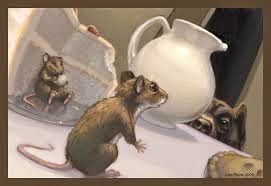
Are you a town mouse or a country mouse?

This is not really a story about whether you were born in the country or the city.  Reading the moral at the bottom, the story presents a choice between a simple, perhaps boring, but safe life and an exciting and dangerous one. 

Aesop clearly recommends the simple life but which life would you rather have? 
This is an edited version of one of Aesop’s fables... 
 
  The Town Mouse and the Country Mouse
A Town Mouse went on a visit to his cousin in the country.  He was rough and ready, this cousin, but he loved his town friend and made him heartily welcome.
Beans and bacon, cheese and bread, were all he had to offer, but he offered them freely.  The Town Mouse turned up his nose at this country food, and said: "I cannot understand, Cousin, how you can put up with such poor food as this, but of course you cannot expect anything better in the country; come with me and I will show you how to live.  When you have been in town a week you will wonder how you could ever have stood a country life."
No sooner said than done: the two mice set off for the town and arrived at the Town Mouse's residence late at night.
"You will want some refreshment after our long journey," said the polite Town Mouse, and took his friend into the grand dining-room.  There they found the remains of a fine feast, and soon the two mice were eating up jellies and cakes and all that was nice.
Suddenly they heard growling and barking.  "What is that?" said the Country Mouse.
"It is only the dogs of the house," answered the other.
"Only!" said the Country Mouse.  "I do not like that music at my dinner."
Just at that moment the door flew open, in came two huge dogs, and the two mice had to scamper down and run off.
"Good-bye, Cousin," said the Country Mouse.
"What! going so soon?" said the other.
"Yes," he replied; "Better beans and bacon in peace than cakes and ale in fear."
 

Vocabulary:
a moral – A teaching point in a story.
a fable – A made-up story or tale.
to be rough and ready – To be unsophisticated.
to turn up your nose – To reject something because you feel it is beneath you.
“No sooner said than done” – This is an expression which means that what has been said can be quickly put into action.
to scamper – To run in a clumsy manner.


Thursday, 25 September 2014

Little Scotia and the marriage crisis -リトル・スコーシャと離婚の危機(スコットランドとイギリス連邦の危機)


Little Scotia threatened a divorce.  She demanded a meeting with her husband to let him know the list of her grievances.

She complained that although she worked just as hard as her husband, he was keeping control of the money for both of them.

She claimed that she had brought expensive jewellery into the marriage: fine black-gold jewellery.  And now she demanded it back.
She demanded that her husband remove his guns from her room.  He has very big guns, which he says are necessary to defend both of them and their friends as well.  Only, he doesn’t have enough room in his bedroom, so would Little Scotia mind awfully if he kept the guns in her bedroom instead?
Little Scotia’s husband laughed at her threatened divorce.  He told her she could never make it on her own.  Where would she find work?  What friends would help her when the membership cards for all the clubs they went to were in her husband’s name?  What money would she use when her husband had control of their joint bank-account?
But Little Scotia was brave and insisted that despite all her husband’s threats, she would still seek a divorce.  She could make it on her own.  She was resourceful.  Hadn’t she contributed at least equally to this marriage?  Who had installed the telephone?  Or the television?  And if there was a problem with money, didn’t she still have all that expensive jewellery?
She was going to use her freedom to make a better life for herself and her children.  Her husband had sold their disabled son’s wheelchair, claiming that they were too poor to afford it any longer, as he puffed on his cigar.  Little Scotia would buy it back.  She would look after the health of all her children equally, no matter how much money they had to repay her.  Her husband had said that their children should start paying money for their own medicine, since the couple no longer had enough money to be generous, as he sipped champagne with his old Eton classmates.
As the date of the divorce drew close, her husband began to worry that his wife might actually go through with it.  He promised changes.  There would be... well, he wasn’t sure exactly what, but there would definitely be changes.  And Little Scotia could have more control over her pocket money.
Little Scotia thought long and hard about it.  She thought about the threats, the promises, her jewellery... 
And she decided that they were better together after all.  Her husband was a good man, a little selfish perhaps.  A little wont to talk about past glories, perhaps but essentially a good man.  Look: there he is now, chatting with his banker friends and taking good care of the money.  I wonder if he’s paying back debts he incurred on his recent trip to Iraq?
Good luck, Little Scotia.  You’re better than you know.


Thursday, 18 September 2014

This is what happens to bad students (Pinocchio in Toyland)


This week I finished reading The Adventures of Pinocchio for the first time.  It was written by Carlo Coloddi and published in Italian in 1883.

It concerns the wooden marionette, Pinocchio, who is a very bad son to his poor father, Geppetto.  It contains many cautionary tales about the bad things that will happen to bad boys.

I hope that you are all studying English hard.  Because the story also contains a moral for those who neglect their studies.  The copyright for this work has expired, so I hope that Carlo Colloddi won’t mind if I summarise Pinocchio’s misadventure when he neglects his studies to go to Toyland...


An episode from “The Adventures of Pinocchio”,: Toyland

"Why don't you come to Toyland with me?" Lampwick said. "Nobody ever studies there and you can play all day long!"

"Does such a place really exist?" asked Pinocchio in amazement.

"The wagon comes by this evening to take me there," said Lampwick. "Would you like to come?"

Forgetting all his promises to his father and the fairy, Pinocchio was again heading for trouble. Midnight struck, and the wagon arrived to pick up the two friends, along with some other lads who could hardly wait to reach a place where schoolbooks and teachers had never been heard of. Twelve pairs of donkeys pulled the wagon. The boys clambered into the wagon. Pinocchio, the most excited of them all, jumped on to a donkey. Toyland, here we come!

Now Toyland was just as Lampwick had described it: the boys all had great fun and there were no lessons. You weren't even allowed to whisper the word "school", and Pinocchio could hardly believe he was able to play all the time.

"This is the life!" he said each time he met Lampwick.

"I was right, wasn't I?" exclaimed his friend, pleased with himself.

"Oh, yes Lampwick! Thanks to you I'm enjoying myself. And just think: teacher told me to keep well away from you."

One day, however, Pinocchio awoke to a nasty surprise. When he raised a hand to his head, he found he had sprouted a long pair of hairy ears, in place of the simple ears that Geppetto had never got round to finishing. And that wasn't all! The next day, they had grown longer than ever. Pinocchio shamefully pulled on a large cotton cap and went off to search for Lampwick. He too was wearing a hat, pulled right down to his nose. With the same thought in their heads, the boys stared at each other, then snatching off their hats, they began to laugh at the funny sight of long hairy ears. But as they screamed with laughter, Lampwick suddenly went pale and stumbled. "Pinocchio, help! Help!" But Pinocchio himself was stumbling about and he burst into tears. For their faces were growing into the shape of a donkey's head and they felt themselves go down on all fours. Pinocchio and Lampwick were turning into a pair of donkeys. And when they tried to groan with fear, they brayed loudly instead. When the Toyland wagon driver heard the braying of his new donkeys, he rubbed his hands in glee.


Vocabulary:
a misadventure – An adventure that goes wrong; a bad experience.
to neglect something – Not to do something that you should.
a lad – A boy
to clamber – To climb in a clumsy way
“This is the life” – This is an expression which people say when they are enjoying luxury.  For example, you might say it when drinking champagne and eating truffles.
nasty – Very unpleasant.
to sprout – To grow quickly.
to snatch something – To grab something; to take it very quickly with your hand.
to stumble –To nearly fall over.
to bray – This is the noise that a donkey makes.
glee – Great happiness or joy
 

Thursday, 11 September 2014

There is strength in perseverance


Perseverance is an important concept in Japanese culture.  There are a number of idioms which attest to this. 

One of these is “Keizoku ha chikara nari.”  I have seen an English equivalent, “Perseverance is the key”, although I have never heard anybody say it.  A more literal translation would be “There is strength in perseverance.” 

Another idiom is “Ishi no ue nimo 3nen.”  Literally, that means “Three years on the rock.”  This means that if you do something, you should stick at it for three years.  Many Japanese employers look at a job candidate’s career history and are suspicious if someone has frequently changed jobs.  To avoid giving this impression, I guess that many Japanese employees stick at jobs they don’t like for several years, especially if it is their first job.  Perhaps some people in Britain do that too but it is less of a stigma to change jobs.  Indeed, it might be seen positively, as a sign of ambition. 

Well, perseverance may be the key but it can also be very difficult.  I used to drink alcohol almost every night (not that much, don’t worry!)  A couple of months ago I decided to stop drinking completely on Monday, Tuesday and Wednesday nights.  I am writing this on a Wednesday, and I can’t wait for Thursday to come around.  There is a glass of sho-chu calling my name... 

Anyway, the point I’d like to make is that it is important to be realistic.  If I had set myself the target of cutting out all alcohol from Monday to Friday, I suspect I would have failed after three weeks.  If you want to lose weight, why not stop eating snacks for three days a week?  Too many people try to make a radical change, perhaps cutting out snacks altogether.  Then it is all too easy to fail after a few weeks and put all the weight you initially lost back on. 

Try a small improvement.  And stick at it for three years.  There is strength in perseverance, or so I have heard.
 

Vocabulary:
perseverance – The habit of continuing to do something even if there is a temptation to quit.
concept – Idea; thought.
to attest to something – To give proof or evidence of something.
equivalent – A similar example in another setting.
literal – Word for word.
to stick at something – To keep doing something; to persevere at something.
a stigma – A black mark against someone’s name.
radical – Extreme; involving a big change.


Thursday, 4 September 2014

The Finger-reader

There are a lot of gadgets available for people with a visual impairment.  I am writing this on my laptop, using screen-reader software called ”Jaws”.  If on Microsoft Word I press the space bar, the software will say, “Space,” in an artificial voice.

There is a new kind of technology which is being developed now by the Massachusetts Institute of Technology (MIT) which could be similarly useful in the future.  It also has a similar name.  It is not a screen-reader but a “finger-reader”. 

Apparently, it uses a camera mounted on a ring.  You put this ring over your index finger and you point the camera at any text you want to read.  The device will then scan this and read the text aloud using an artificial voice. 

It sounds like this would be very difficult to use.  If you cannot see the text you are trying to read, how do you know where to point the camera?  Well, according to MIT, the device scans the line of text and determines the direction that it should be read.  If the user’s finger strays away from the correct line, then the device vibrates to let him know. 

I like to think that this is only the beginning.  One day I want a camera in my hat.  It will look at everything in front of me and give me helpful advice.  For example, it will say “Cute girl!” or “Scary guy!” into an earpiece.

Sadly, for the time being I’ll have to wait and see how expensive this finger-reader is...


Vocabulary:
 
a gadget – A kind of useful technology, especially electronic.  A smart-phone or remote control are gadgets.
 
a visual impairment – A problem with your sight.  This includes people who are blind, like me, and people who have weak eyesight.

artificial – Man-made; not natural.

to be mounted – To be placed on top of something.  For example, the rider was mounted on a beautiful horse.

index finger – The finger next to your thumb.  People use this finger to point at things.

to stray – To go off course.

to vibrate – To shake very quickly.  A mobile phone on silent mode usually vibrates if someone calls you.