Thursday, 13 November 2014

The heart of things

This week I finished reading “Kokoro” by Soseki Natsume.  I have heard that most Japanese students study this book in high school.  So I suspect that many people will be intimately familiar with the story.

But it is not so well known in Britain.  So let me first summarise the story.  The title means “heart” but also suggests other meanings such as inner feelings or the true nature of things.
The book was written in 1914 and is set in that period, the end of the Meiji Era.  That was the era which saw the modernisation of Japan.  The book follows the relationship between the narrator, a young university student, and an older man, who lives virtually as a recluse in Tokyo with his wife.

The older man, whom the student respectfully calls “Sensei”, over the course of the book reveals the reason for his withdrawal from human society, including feelings of guilt over an incident in a complicated love-triangle and his inability to come to terms with the new modern Japan.
As a psychological study of human nature and isolation it was very interesting.  The characters are constantly misunderstanding one another and even themselves.  They are contradictory and often show completely conflicting desires.  As a small example, the narrators’ parents are desperate to see their son and urge him to come back from university.  After the first few days, they get annoyed with having him there and wish he would leave.  When he decides to go back to Tokyo, however, they ask him to stay longer.  The complexity of the human mind, which pushes and pulls in different directions at the same time, and can never be fully understood by others is brilliantly explored.

I must admit that I did also get a bit annoyed by the character of Sensei, however.  He had grown up influenced not just by the modern Japan, but the older values as well.  Every relationship he had was strictly governed by rules, ritual and obligation.  He gave advice to his friend K, and felt completely bound by an obligation to help him at great cost to himself because the advice brought some difficulties.  He delays declaring his love for someone for a number of reasons, including fears that it might cause him embarrassment or was not correct according to custom.
As a modern, selfish man brought up in an individualistic culture, I kept thinking, “Just do it!  Stop worrying so much about what other people think!” or similar thoughts.  If old Japan was really as strict as Sensei shows it to be, then it must have been a hard place to live.

Actually, it’s not always that easy even now...
 

Vocabulary:

to be intimately familiar with something – To know something extremely well.
virtually – Almost entirely.

a recluse – Someone who lives completely apart from other people.
a love-triangle – When two people love the same person, it is a love-triangle.
to come to terms with something – To accept something; to be able to deal with something.

psychological – To do with the way people think.
isolation – Being alone.

to be contradictory – To contain two opposites.  For example, “I like cats but I don’t like cats”, is a contradictory statement.
conflicting – Opposite or not in agreement.

to urge someone to do something – To strongly encourage someone to do something.
complexity – Being complex; the opposite of simplicity.

ritual – A ceremony, or a traditional, formal action.
obligation – A responsibility to do something.  For example, “He helped me, so I have an obligation to help him in return.”

to be bound – To be unable to move; to be tied up.


Thursday, 6 November 2014

Bear Mountain picnic

Over the long weekend, I went on a short hike with my wife and her sister and two young nieces.  One of the girls is a first grade elementary school student and the other is a sixth grade student.  So, as you can imagine, we chose a hike that was not too long or difficult. 

We climbed to the top of Mount Tenran (Tenran-zan), in Hanno.  We climbed a steep slope with wooden steps to get to the top.  For most people it probably wasn’t a difficult climb, but for a blind guy and a first grader it was pretty taxing.
One of the first things we noticed was a sign that warned that bears had been spotted in the area.  My wife’s younger niece asked if I was swinging my stick in front of me to keep the bears away.  I rather like the idea.
We were all tired when we reached the top and so took a break to have a picnic.  We had onigiri and mikan.  Actually, we had onigiri, mikan and fried chicken which my sister-in-law had brought.  She obviously hasn’t been reading my blog.  I decided not to tell her that I had become a semi-vegetarian and just ate it.  I must admit that it tasted nice.
The real difficulties began on the way down.  We took a different route down the mountain.  Instead of wooden steps, there were boulders, mud and a more gradual slope to the bottom.  Unfortunately, I hadn’t checked my shoes very carefully before I came out.  They were an old pair of shoes and the soles had worn completely smooth.  The day we went hiking, Sunday, was dry.  But the previous day it had rained heavily and the boulders and mud were still wet.
So I was slipping and sliding the whole way down, holding on to my wife’s arm and using my bear-stick to test the ground in front of me and to help support my weight.  I nearly fell over a number of times and other hikers were shouting out encouragement or warnings.
We made it to the ground in the end.  My trousers and shoes were covered in mud and everybody’s legs were sore.  But we weren’t eaten by bears and we got home safely.
I think the bears must have been frightened off by my bear-stick.
 

Vocabulary:
a long weekend – If Monday is a public holiday, we call this a long weekend.

to be taxing – To be tiring; to cost a lot of energy.
to spot something – To see or notice something.

a boulder – A big rock.
gradual - Happening slowly.
a number of – Several.


Thursday, 30 October 2014

A grave message...

Today’s post covers the delicate topic of death and people’s reaction to it, including humour. 

British culture is characterised by a cynical and often black sense of humour.  Do you find this story a little bit funny or are you sorry for the person affected?

To summarise the story, an elderly lady passed away.  When someone dies in the U.K. it is common to bury them with some personal items they were fond of: a teddy bear, perhaps, or a football scarf.

Well, apparently this elderly lady was fond of sending text messages and using her mobile phone.  So she was buried with her mobile phone.  This happened three years ago or so.

This deceased lady’s granddaughter continued to send text messages to her grandmother even after she had died.  Of course she knew that her grandmother couldn’t read them but sending the messages gave her comfort.  “I know she’s not alive.  But it’s still going to her,” she said.  So far it’s a sweet story, right?
But then after three years of this, the granddaughter received a reply.  It said, “I’m watching over you.”
The granddaughter’s reaction was then quite strange.  She said: "Loads of horrible things were running through my head.
"How did somebody get her telephone? Had they been getting all the texts?"
So, she imagined that someone had dug up the grave in order to steal the phone.  This is not the first explanation that she should have considered!
In reality, the phone company had given the old number to someone else, because it had not been in use for three years.  So a stranger was getting the text messages that the granddaughter was sending and, being a cynical Briton with a black sense of humour, he assumed that his friends were playing a prank on him.
The granddaughter said, “I took it out on him.  But it wasn’t his fault at all.”
I’m sorry but I found the story quite amusing.  I am sure that amongst us cynical Britons, I wasn’t the only one.


Vocabulary:
a delicate topic – A sensitive subject; something which is difficult to talk about.

A is characterised by B – Something distinctive about A is B.
to be cynical – If you are cynical then you don’t respect things as they appear, or make fun of things.
to pass away – To die.  It sounds more polite to say that someone passed away, rather than that they died.
to bury something – To put it in the ground, under the earth.
to be deceased – To be dead.  It sounds more polite to say deceased rather than dead.
loads of... – Lots of...; a large pile of...
to dig something up – To take something out of the ground.
a grave – The place where someone is buried
a prank – Telling someone a false story as a joke.  For example, people often play pranks on each other on April Fool’s Day.

a Briton – Someone from Britain
to take it out on someone – To get rid of some negative feeling like anger by attacking or blaming someone.


Thursday, 23 October 2014

Sorry, you are a “semi”-vegetarian?


To understand this week’s blog entry, you must first understand the prefix “semi-”.  Draw a circle on a piece of paper.  Now draw a line down the middle, cutting it in half.  You now have two semi-circles.  So “semi-something” means half-something or part-something.  If you are a semi-skilled worker then you are less skilled than a “skilled worker”, and more skilled than an “unskilled worker”. 

What got me thinking about this prefix was telling someone that I had become a “semi-vegetarian”.  He laughed.  I think I can see why.  He felt that I should either be a vegetarian or not be one. 

But let me explain myself.  First, I don’t eat meat at home.  If I go to a restaurant and all of the dishes contain meat then I will just eat meat instead of trying to find another restaurant.  My own convenience is also important.  I am sure I would eat my own students if I was hungry enough and there was no tofu around! 

Also, I eat fish.  I am not against eating animals.  Humans are omnivores, and we evolved eating animals.  But the way we usually farm food like chickens and cows is so terrible for the animals that it is no longer natural.  It is a kind of cruel torture.  I would be happy if animals could be farmed more expensively, giving them enough space to move around and the chance to live without too much suffering.  Meat would then be very expensive but perhaps we could eat less of it. 

If fish are not farmed, and are caught directly from the ocean, I feel that they had some chance to live life naturally before being eaten to sustain another’s life.  So I don’t object to eating fish.  If meat, eggs etc. are clearly labelled “free range”, then I think that is okay too, but it is usually very difficult to tell how meat products were produced. 

I am not trying to campaign on this issue.  I don’t get angry about other people’s opinions on eating meat.  I am just a semi-writer giving a semi-opinion.
 

Vocabulary:
a prefix – Something which is added to the start of a word to change its meaning.  For example, “unclear” contains the prefix “un”.
an omnivore – An omnivore is an animal which eats both plants and meat.  A carnivore eats only meat and a herbivore eats only plants.
torture – Extreme pain which is caused deliberately.
to sustain something – To support something; to enable it to continue.
free range – In free range animal products, the animals were given enough space to walk around freely.  Most meat is factory farmed.  That means that the animals cannot move, probably for their whole life.
 

Thursday, 16 October 2014

A cat lover by nature


Are you a cat lover?  I am.  When I was young, my family bought a cat from a dog and cat home.  That means that she had been owned by another family who had decided they didn’t want her and gave her away.

So we didn’t decide her name.  She already had the name “Domino”, since she was a white cat with black spots.  A domino is a small rectangular black block with white spots, used in a game.  So the name was quite appropriate. 

Domino was very shy and nervous at first.  She didn’t like to be touched by humans much and would sometimes turn around and give us a warning bite if we tried to pet her.  I would probably be shy and nervous if I had been thrown out by my family too. 

But after many months and years she got used to people.  She became very friendly and would jump onto your lap to be petted.  You could say that over time she learned to change her nature. 

But Aesop would disagree.  Below is another one of his fables, in which he suggests that someone or something’s essential nature can never change. 

He also has a different idea of what is meant by a ‘cat lover’...


The Cat Maiden 

The gods were once disputing whether it was possible for a living being to change its nature.  The king of the gods said "Yes," but the goddess of love said "No."
So, to resolve the dispute, the king of the gods turned a cat into a maiden, and gave her to a young man for a wife.  The wedding was duly performed and the young couple sat down to the wedding-feast.
"See," said the king of the gods, "how appropriately she behaves.  Who could tell that yesterday she was but a cat?  Surely her nature has changed?"
"Wait a minute," replied the goddess of love, and let loose a mouse into the room.  No sooner did the bride see this than she jumped up from her seat and tried to pounce upon the mouse.  "Ah, you see," said the goddess of love,
"Nature will out."

 
Vocabulary:

rectangular – The shape has four sides.  It is like a square, but two of the sides are longer than the other two.
a dispute – An argument or discussion with opposing sides.
a maiden – A young, unmarried woman.
“The wedding was duly performed” – 1. The wedding was soon thereafter performed. /  2. The wedding was properly carried out.
to let loose something – To release something, especially something dangerous.  For example, don’t let loose the dog.
“No sooner did the bride see this than she jumped up” – The bride saw this and then immediately jumped up.


Thursday, 9 October 2014

Political correctness comes to Toyland

A few weeks ago I posted an extract from Carlo Collodi’s “The Adventures of Pinocchio”, written in 1883.  I have since found details of a controversy which arose in Japan about this work.
 

Political correctness, or PC, has become increasingly important in many countries like my native Britain in recent years and decades.  It is basically an attempt to find an agreed way to talk about sensitive topics, such as race, disability, religion etc. in a way which will not cause offence.  To be politically correct, we have to avoid using discriminatory words.
 
That sounds reasonable, right?  But many people complain that we do this too much, that sometimes the media or others are too concerned to promote political correctness.  A popular phrase you will hear in Britain is, “It’s PC gone mad!” which means that someone is taking far too much care to be politically correct.

I’ll give you an example.  Every school in Britain will have a holiday on 25th December because it is Christmas Day.  Yet some schools have changed the name of this holiday from “Christmas holiday” to “Winter festival holiday” or something similar.  This is done to avoid offending people who are not Christians.  Many parents, though, complained that this was “PC gone mad.”

So how does this relate to Pinocchio?  Well, there are two disabled characters in the story.  There is a blind cat and a lame fox.  The characters are portrayed very negatively.  They try to trick Pinocchio to steal his money and end the book as beggars. 

In the 1970s, the Japanese translation of The Adventures of Pinocchio was withdrawn by some publishers because the book was not seen as politically correct.  There were some discriminatory words: Blindness was translated as “mekura” (dark eyes) and lameness as “bikko” (lameness).  There was also concern that the book portrayed the disabled as evil, or as failures.

Later, the translation was revised.  “Mekura” was changed to “Me no warui” (bad eyes) and “bikko” was changed to “ashi no warui” (bad legs).  They decided not to change the story, and left the disabled characters as evil failures.

Did they make the right decision?  About the Japanese translations of blindness and lameness, I don’t know enough to say which translations are best.  But about not changing the story, for me they were right.  You shouldn’t change a classic story.  It is a historical document and an important clue as to how people thought at that time.  If we start to change these stories to make them more PC, then how do we know what the original author really thought? 

And also, after reading the English translation, I had the impression that the cat was not really blind, and the fox was not really lame.  I thought that they were pretending to be disabled in order to trick people and beg more effectively.  You see, people who aren’t disabled can be evil and failures too! 

Maybe it was all just PC gone mad...
 

Vocabulary:
a controversy – A major disagreement, with opinions divided.
to cause offence – To make someone angry or upset.
to be discriminatory – To treat a group of people differently from other people, in an unfair way.
 
to portray someone as (evil) – To make someone appear (evil).
to be withdrawn – To be removed.  If a book is withdrawn by the publishers then they will no longer make any more copies.
 

Thursday, 2 October 2014

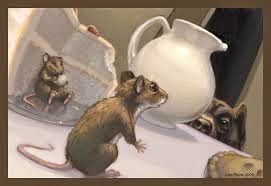
Are you a town mouse or a country mouse?

This is not really a story about whether you were born in the country or the city.  Reading the moral at the bottom, the story presents a choice between a simple, perhaps boring, but safe life and an exciting and dangerous one. 

Aesop clearly recommends the simple life but which life would you rather have? 
This is an edited version of one of Aesop’s fables... 
 
  The Town Mouse and the Country Mouse
A Town Mouse went on a visit to his cousin in the country.  He was rough and ready, this cousin, but he loved his town friend and made him heartily welcome.
Beans and bacon, cheese and bread, were all he had to offer, but he offered them freely.  The Town Mouse turned up his nose at this country food, and said: "I cannot understand, Cousin, how you can put up with such poor food as this, but of course you cannot expect anything better in the country; come with me and I will show you how to live.  When you have been in town a week you will wonder how you could ever have stood a country life."
No sooner said than done: the two mice set off for the town and arrived at the Town Mouse's residence late at night.
"You will want some refreshment after our long journey," said the polite Town Mouse, and took his friend into the grand dining-room.  There they found the remains of a fine feast, and soon the two mice were eating up jellies and cakes and all that was nice.
Suddenly they heard growling and barking.  "What is that?" said the Country Mouse.
"It is only the dogs of the house," answered the other.
"Only!" said the Country Mouse.  "I do not like that music at my dinner."
Just at that moment the door flew open, in came two huge dogs, and the two mice had to scamper down and run off.
"Good-bye, Cousin," said the Country Mouse.
"What! going so soon?" said the other.
"Yes," he replied; "Better beans and bacon in peace than cakes and ale in fear."
 

Vocabulary:
a moral – A teaching point in a story.
a fable – A made-up story or tale.
to be rough and ready – To be unsophisticated.
to turn up your nose – To reject something because you feel it is beneath you.
“No sooner said than done” – This is an expression which means that what has been said can be quickly put into action.
to scamper – To run in a clumsy manner.