Thursday, 26 March 2020

There Are Still a Few Reasons to Laugh, Despite the Coronavirus -コロナウイルスにもかかわらず、まだ笑う理由がいくつかある-


There is lots of terrible news about the coronavirus pandemic.  It is important to read enough about the subject in order to understand how to protect yourself and other people – Wash your hands with soap, stay away from groups, etc.  But I think it is important not to read too much about it.  After a while, there is no more useful information you can get, and all the awful stories will make you panic or feel depressed. 

So you must try to find a few stories you can laugh at too.  Here are three which made me laugh recently.


1 –Watch what people do, not what they say 

When people started panic-buying toilet paper and pasta in the U.K., I talked with my father on the phone.  “These people are crazy,” he said.  “From everyone’s ridiculous over-buying, you would think the end of the world was coming!  They really ought to know better.” 

Then when he passed the phone over to my mother, she told me that there was hardly any room to move in the house because of all the toilet paper and pasta that my father had been buying.


2 –Cynical citizens 

An acquaintance who is an office worker in a Japanese company overheard an interestingly cynical conversation. 

The Japanese CEO was talking about why Europe and America seemed (so far) to be suffering worse than Japan. 

“It is lucky that we Japanese are so well-behaved, conscious of health and cleanliness, and willing to follow the rules.  Even with an incompetent government and weak leadership, we can still survive better than many countries.”


3 – Pretty eyes 

My wife sat alongside one of her female colleagues for several hours at work.  Her colleague’s pretty eyes peeked out from above her mask, which she wore even indoors. 

Then, during a break, my wife got a surprise when her colleague took off her mask to sip some tea.  A bare and slightly red face appeared below the heavy eye-shadow and fake eye-lashes.  The woman had only bothered to put on the make-up which would be visible when wearing a mask. 

“It saves a lot of time” she explained, happily.


Vocabulary:

a pandemic–the spread of a disease over many countries or a very wide area

cynical – distrustful of human sincerity or good motives

to overhear something – to hear something by accident

incompetent – not having the skills to do something well

to peek out – to be slightly visible


Wednesday, 18 March 2020

Becoming No Feet -アシナシになること-


I was amazed recently to find that children are as flexible as snakes. 

My son woke up one morning, and couldn’t walk, or even stand up. 

“It’s time to wake up!  Come and join Mummy and Daddy for breakfast,” I said to my son. 

“I can’t get out of bed.  My knee is painful!” he answered. 

I assumed that he was lying.  The reason I assumed this was because just a few days earlier, he had fallen over at the nursery and slightly hit his knee.  The nursery teacher told us that he wanted sympathy, and dragged his leg along the ground for a while, pretending that his knee had been badly injured.  I thought that he must be doing the same thing again.  Like the boy who cried, “Wolf!” he was having trouble making people believe him a second time. 

But eventually we realised that he was not pretending, and really couldn’t stand up.  My wife carried him to a paediatrician, who examined his legs.  His knee was fine, but his hip joint was swollen (due to a virus).  The doctor said that this sometimes happens with young children, and that he would probably get better after a few days rest. 

So we encouraged our son to have a rest on the futon at home.  When it was dinner time, we asked him if he wanted to eat. 

“Okay,” he said.  “But I still can’t walk.  My knee is painful.” 

“Do you want Daddy to carry you to the living room?” I asked. 

“No!” he said.  “I can do it by myself!” 

Then he pulled back the covers he was lying under, and slithered from the bedroom to the living room on his belly like a snake.  “I am No Feet!” he said happily.  “Mummy, look at me!” 

No Feet is a character in my son’s favourite Youtube programme – a Canadian cartoon called “Little Bear”.  No Feet is Little Bear’s friend, a snake. 

If an adult suddenly lost the use of their legs one day, they would almost certainly panic.  They would worry that they might never recover, and feel frustrated and fearful.  A three year old’s mind is as flexible as their body.  They just pretend to be a snake and happily crawl around the floor. 

My son has recovered, and is running around again.  But I am sure there is some lesson in life to be learned from No Feet.


Vocabulary:

flexible – capable of bending and changing shape easily without breaking

to assume something – to suppose something, without proof

to pretend – to act as if something were true, when it is not

to drag something – to pull something heavy along the ground

a paediatrician – a specialist doctor for children

one’s joint – a part in the body where one area connects with another, allowing movement

to slither –to move smoothly across the ground in a forward-twisting motion; to move like a snake


Wednesday, 11 March 2020

It’s a Dog’s Life ーそれは犬のようにみじめな生活だー


How would a cute little dog with a fluffy tail feel if it came face to face with a lean and powerful wolf? 

How would you feel if you came face to face with a spear-carrying human who was stronger, smarter and faster than you? 

I was reading a book about the early history of mankind’s evolution.  It said that, based on estimates of the skulls of hunter-gatherer humans from 30,000 years ago, those early humans had brains which were 10 to 14 per cent larger than our modern brains.  Based on analysis of ancient footprints preserved in rock, those early humans could run faster than modern athletes. 

In other words, we are the human equivalent of cute little dogs with fluffy tails, in comparison to our wolf ancestors. 

Any group of animals which is domesticated – kept on a farm or in a house and looked after by humans – will experience the same phenomenon.  Their brains will shrink, and they will become less powerful and able to defend themselves.  For farm animals, of course, they will get fatter and more docile as the farmers select the animals which are the easiest to look after and which produce the most meat. 

Have humans domesticated themselves like farm animals?  A tiny group of humans called “the government” looks after the rest of us.  It is easier for them if we are docile and stupid.So they give us beer and tv shows.  And we wag our cute little tails happily.


Vocabulary:

lean–without any unnecessary fat; thin but fit and strong

a spear – a weapon with a sharp point on the end of a long pole

an estimate – a guess based on good evidence

analysis – detailed examination of something

an equivalent–something which is the same in some way, such as value or function

to shrink – to get smaller

docile – ready to accept control or instruction; not rebellious


Wednesday, 4 March 2020

How to Fall Off the Edge of the Earth-どうやって地球の縁から落ちるか-


If you didn’t already know, let me tell you how to fall off the edge of the Earth.  Just walk to the edge, and then keep walking. 

* 

Adapted from the prologue to Terry Pratchett’s novel, “The Colour of Magic”: 

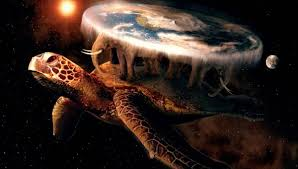
The Great Turtle comes, swimming slowly through space, his huge and ancient shell marked with meteor craters.  In a brain bigger than a city, with thoughts moving as slowly as a continent, he thinks only of the weight on his back.  On his back are the four Great Elephants, forever marching in a circle.  On their shoulders they carry the world.  The world is a huge flat disc. 

For a long time no one on the world knew that they lived on a flat disc, which was carried on the shoulders of four moon-sized elephants, which were carried on the back of a planet-sized turtle.  Then people from a kingdom on the very rim of the world built a large glass box, put some explorers in it, and lowered it over the edge.  These astronauts could then see the Great Elephants and the Great Turtle living under their feet. 

* 

Some people believe, or at least say that they believe, that the Earth is really flat.  They are called “flat-Earthers”. One flat-Earther died last month in the launch of a home-made rocket.  He was known as “Mad” Mike Hughes, and he was trying to reach a height of 5,000 feet in order to check for himself whether the Earth was flat. 

I am quite happy that the Earth is round.  If it were flat, I might fall off the edge.If somehow one side of the flat Earth were tipped up slightly higher than the other, we would all start tumbling towards the lower edge.  We might have to live our lives tied to trees in case this happened. 

Mad Mike lived in America, and spent about 18,000 Dollars to build his rocket.  If his goal was to prove that the Earth was flat, wouldn’t it have been cheaper and less dangerous to buy a round-the-world plane ticket?


Vocabulary:

the edge of something –the outside limit of something

to be adapted– to be altered or changed; based on an original work

a meteor crater – a round hole in the Earth, planet or asteroid where something from space has collided and left a mark

a continent – a large land-mass, such as North America or Africa

the rim of something – the edge of something round, such as a plate or bowl

to tumble – to fall suddenly, clumsily, or headlong


Thursday, 27 February 2020

What It’s Like for a Foreigner Going Blind in Japan -外国人が日本で目が不自由になるってどんな感じ-ジャパンタイムズに記事が掲載れさました

I have just written an article about going blind in Japan, which was published in The Japan Times.  I have heard that it has some cute illustrations.  Please take a look and tell me who is cuter – me or the character?
                                                  
[ウィルのジャパンタイムズの記事リンク 2020/2/27]

In the article I mention some of the interesting things which happened to me when I lost my eyesight.  I talk about nearly getting run over by a truck, being thrown out of a bar, beingsaved by a vending machine, and feeling a tingle of excitement when a civil servant suddenly holds my hands.

It is quite long, and probably difficult for non-native speakers to follow.  But at least you can enjoy the cute pictures.

Vocabulary:

to be run over – to be hit by a car or vehicle, and for it to drive over the top of your body

to be thrown out (of a bar) – to be forced to leave (a bar)


a tingle - a feeling when your nerves are excited, often feeling like pins and needles

Tuesday, 18 February 2020

Alexa, Throw 10 Billion Dollars Into a Huge Hole ーアレクサ、巨大な穴に10憶ドルを投げてー

Imagine that you had so much money that you could drop a billion Dollars down the back of the sofa, and completely forget about it.  That must be what it is like for Jeff Bezos, the founder of Amazon, who is the world’s richest man.  He is estimated to be worth 130 billion Dollars.  This week he announced that he is planning to use 10 billion Dollars of his huge wealth to fight climate change.  I suppose that can only be good news.
                                                              
The 10 billion Dollar donation only adds up to around 8 per cent of the businessman’s total wealth.  What if he met you in a coffee shop and, impressed by your intelligence and good character, he decided to give you another 10 billion Dollars to help the world?  How would you spend the money? 

How about dividing the money equally amongst all people on the planet?  With 7.8 billion people currently living here, everyone would in theory receive a little more than 1 Dollar each.  According to UN statistics, more than 1 billion people live on less than 1 Dollar per day.  So the gift might not mean much to you or me, but a lot of people would be very glad to receive it. 

The problem with this idea is that it would be impossible to administer.  You would have to hire an organisation in every country in the world in order to distribute the money.  That would probably eat up most of the money on administration costs, and leave littleto give out.  Besides, you would give money to lots of people who didn’t need it, such as Queen Elizabeth and the Sultan of Brunei. 

So, instead of spreading the money really thinly, how about throwing everything into one huge hole?  The Channel Tunnel linking Britain and France under the English Channel has the longest underwater section of any tunnel in the world–23 miles. 

Unfortunately, the Channel Tunnel eventually cost 21 billion Dollars to build, and it was finishedin 1994.  In today’s money, 10 billion dollars could only build a smaller underwater tunnel, perhaps one quarter of the length.  Northern Ireland is about 12 miles from Scotland at its closest point.  Perhaps you could offer to build a tunnel half-way across, and hope that Britain finished the other half. 

I’m sure that there are smarter and more effective ways to make use of 10 billion Dollars than I have suggested.  If you have any good ideas, just tell Alexa, Amazon’s AI virtual assistant.  There are already more than 100 million Alexa enabled devices in the world.  And Amazon is using them to listen carefully to what people around the world want.  Why not make a good suggestion directly to Mr. Bezos?


Vocabulary:

a billion – 1,000,000,000

“He is estimated to be worth” – people guess that his total wealth is
a donation – money given as a gift, especially to charity

to eat up (money) – to use up money, especially wastefully

virtual – not physical, e.g. Only existing on the internet  or in a computer

(Alexa) enabled – with the ability to use (Alexa)


Thursday, 13 February 2020

The Forgetful Gunman ー忘れっぽいガンマンー


There is a scene in the movie, “Pulp Fiction,” in which an assassin goes to someone’s house in order to murder them.  When he gets to the target’s house, he finds that no one is home, and the place is in a mess.  The target,who knows that a crime boss is angry at him, seems to have fled.  So the assassin relaxes, and goes to use the toilet.  He leaves his gun on a kitchen table as he uses the lavatory.  Unfortunately for him, the target comes back to pick up an important watch.  He finds the gun on the kitchen table.  Then he finds the assassin in the toilet.  And he shoots him. 

Is that a realistic story?  Could an assassin really be so stupid that he would leave his gun in the kitchen when he goes to use the toilet in his target’s house? 

A recent story from real life suggests that this is not so unrealistic.  A former British Prime Minister, David Cameron, was taking a flight from New York to London.  He was accompanied on the British Airways flight by a police bodyguard.  At one point during the flight, another passenger went to use the toilet.  He found the bodyguard’s passport, the former  Prime Minister’s passport, and a gun.  Apparently, the bodyguard had taken off his gun and put down the passports whilst he was using the toilet.  And he forgot to pick them back up again.  At least the passenger who found them wasn’t a terrorist! 

There are a lot of forgetful people in the world.  I was once on a train and missed my stop because the driver forgot to open the doors.  But it’s a very bad idea to be a forgetful gunman.  I hope the people in charge of the world’s nuclear weapons have good memories.


Vocabulary:

an assassin – a person who tries to murder someone for political or religious reasons

to be in a mess – to be messy or untidy; for things to be scattered about or not in their correct places

to flee (past tense, fled) – to run away or try to escape